
NBI Clearance Fee 2026: How Much Does It Really Cost?
Walk-in, delivery, renewal, and first-time jobseeker fees, broken down clearly, with the real numbers and the honest gaps between sources.
The NBI Clearance fee for a walk-in or pickup application is ₱155 in most cases. That is a ₱130 base fee plus a ₱25 service fee. If you choose door-to-door delivery instead, the total goes up to roughly ₱355 to ₱455, depending on your location. First-time jobseekers can get their clearance for free.
Standard pickup
Door-to-door delivery
First-time jobseekers
Mailed clearance abroad
We are not affiliated with the NBI. Official website: clearance.nbi.gov.ph. Last verified July 2026.
This is an independent guide. We are not the NBI. Always confirm your exact total on the official portal at clearance.nbi.gov.ph before you pay. Fees can shift over time, and we update this page when we find a real change.
The Full Fee Breakdown
Here is the clearest picture we could put together, based on the NBI’s own Citizen’s Charter and several independent sources that agree with each other.
|
Transaction Type |
Mailed clearance (overseas) |
Service Fee |
Delivery Charge |
Total |
|---|---|---|---|---|
|
Walk-in or branch pickup |
₱130 |
₱25 |
None |
₱155 |
|
Door-to-door (Metro Manila) |
₱130 |
₱25 |
₱200 |
₱355 |
|
Door-to-door (Provincial) |
₱130 |
₱25 |
₱300 |
₱455 |
|
First-time jobseeker |
₱0 |
₱0 |
Only if you choose delivery |
₱0 |
|
Mailed clearance (overseas) |
₱130 |
N/A |
₱70 mailing + ₱200 |
₱400 |
Some applicants have reported paying closer to ₱510 for door-to-door delivery, not ₱355 or ₱455. We were not able to fully confirm why this gap exists. It may come down to your exact province, your courier zone, or which payment channel you used. If the amount shown on your screen looks higher than the table above, that does not mean something is wrong. Just check the total carefully before you confirm, since the portal always shows your final amount before payment.
Does the Government’s Own Fee Schedule Say Something Different?
Yes, and we want to be upfront about this instead of hiding it.
The NBI’s official Citizen’s Charter, which is a public document required under the Anti-Red Tape Act, lists fees as ₱115, ₱165, and ₱415, without a clear label for what each one covers. This is different from the ₱155 figure most current sources report.
Government charter documents like this one are not always updated as often as the actual payment system. It is common for the printed or posted charter to lag behind the live portal. Because of that, we lean toward the ₱155 figure, since it matches what most recent, independent sources report. But we mention the charter numbers here so you are not confused if you see them somewhere else.
How Much Is NBI Clearance Renewal?
Renewal costs the same as a new application for basic pickup. You still pay ₱155.
The NBI does not charge extra just because this is not your first clearance. If you choose delivery for your renewal, the same delivery pricing above applies.
For the full renewal steps, including what to do if your old ID number is lost, see our complete renewal guide.
Is NBI Clearance Really Free for First-Time Jobseekers?
Yes. Under Republic Act 11261, also called the First Time Jobseekers Assistance Act, a qualified applicant pays ₱0.
To qualify, you generally need to be:
- A Filipino citizen
- At least 18 years old
- Applying for your very first job, not a renewal
- A resident of your barangay for at least 6 months
- Able to present a Barangay Certification and sign an Oath of Undertaking
Some applicants report that NBI staff check the wording on your Barangay Certification closely. It should clearly state that you are a first-time jobseeker, that you meet the residency requirement, and that your purpose is employment. If any of that wording is missing, staff may ask you to pay the full fee instead. Ask your barangay staff if they are familiar with this specific certification before you leave, since a second trip is easy to avoid.
This benefit can only be used once in your lifetime. For the full step-by-step process, see our dedicated guide for first-time jobseekers.
NBI Clearance Fee From Abroad
If you are overseas and use the mailed clearance option instead of applying in person, the reported total is around ₱400. This covers the base fee, a mailing cost, and a handling charge.
This is different from the regular door-to-door delivery pricing above, since it is built for applicants who are not physically in the Philippines. For the complete process, including how a representative can help you, see our full guide for applying from abroad.
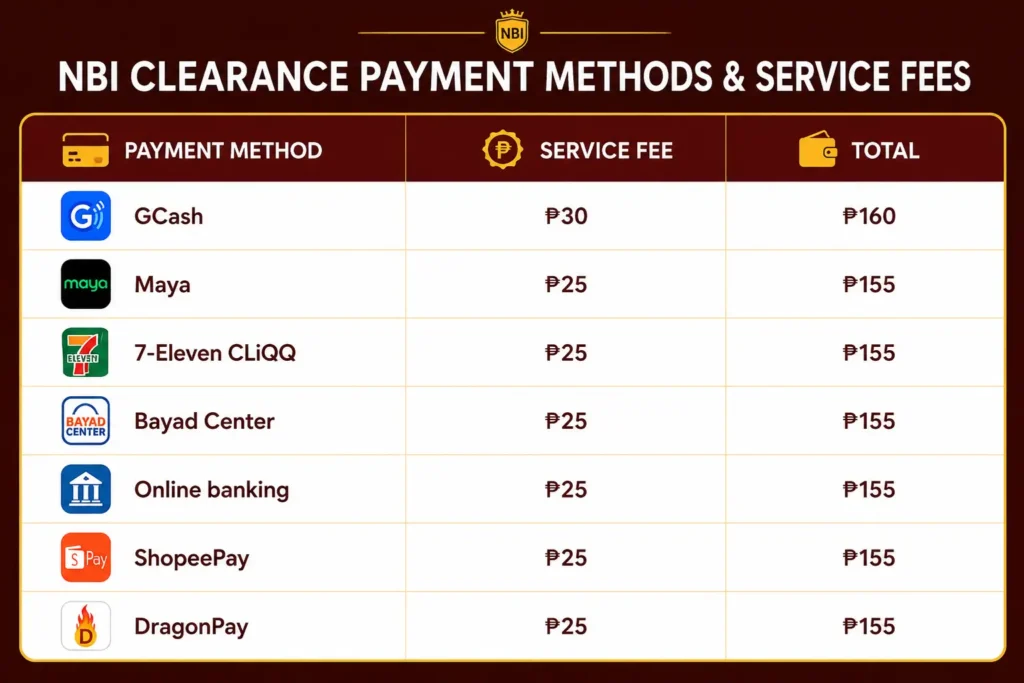
Fee by Payment Method
The base fee stays the same everywhere. What changes slightly is the service fee, depending on how you pay.
|
Payment Method |
Service Fee |
Total |
|---|---|---|
|
GCash |
₱30 |
₱160 |
|
Maya |
₱25 |
₱155 |
|
7-Eleven CLiQQ |
₱25 |
₱155 |
|
Bayad Center |
₱25 |
₱155 |
|
Online banking |
₱25 |
₱155 |
|
ShopeePay |
₱25 |
₱155 |
|
DragonPay |
₱25 |
₱155 |
GCash charges a bit more because it adds its own transaction fee on top of the standard NBI service charge. If you want to save that extra ₱5, paying through 7-Eleven, Maya, or Bayad Center works just as well and costs slightly less.
For a full walkthrough of paying through GCash specifically, see our GCash payment guide.
Does a HIT Cost Extra?
No. A HIT does not add any fee to your application.
You pay once, and that payment already covers the extra verification time if your name gets flagged for a closer look. The only real cost from a HIT is indirect, like a second trip to the branch if you cannot get your clearance the same day. To learn what a HIT actually means and what happens next, read our full HIT guide.
The Most Common Fee Mistake
Here is a mistake that costs real money, and it happens often.
An applicant pays through GCash or 7-Eleven. The portal still shows the payment as pending. They panic and pay again using a different method. Now there are two payments tied to one reference number, and getting a refund for the extra payment is very hard.
The fix is simple. Wait before assuming your payment failed.
- GCash and Maya usually update within a few minutes to a couple of hours
- 7-Eleven and other over-the-counter payments can take up to 24 hours to reflect
If your status still shows pending after waiting, contact your payment provider first, not the NBI. They can confirm whether your money actually went through on their end before you consider paying a second time.
How Fast Is the Process Once You Are Being Served?
This part rarely gets covered, but it comes straight from the NBI’s own official service charter, so we can share it with confidence.
Once you reach the counter, actual processing is quick.
~2 min
Biometrics (1.5 min) + printing (20 sec)
~4–5 min
Encoding + payment + biometrics + printing
If you applied online and already paid, you go straight to biometrics. Fingerprint and photo capture takes about 1.5 minutes, and printing your clearance takes about 20 seconds. That is roughly 2 minutes of actual counter time.
If you are a walk-in applicant, there are a few more steps first. Data encoding takes about 2 minutes, payment at the counter takes about 40 seconds, then biometrics and printing follow the same as above. That adds up to around 4 to 5 minutes total once it is your turn.
This does not include how long you wait in line before your turn, which depends entirely on how busy the branch is that day. Official hours are Monday to Friday, 7:00 AM to 5:00 PM.
Frequently Asked Questions About NBI Clearance Appointments
A Quick Final Word
The number you will pay most often is ₱155. Delivery costs more, first-time jobseekers pay nothing, and a HIT never adds a fee. The one thing worth remembering above all else is this. Whatever total the portal shows you right before you confirm payment is the number that matters most, more than anything you read here or anywhere else.